
The attack is the latest in a string of violence in Pakistan. It comes less ahead of the Shanghai Cooperation Organisation's summit to be held in the national capital.

Twenty-six foreign leaders, including Vladimir Putin and Kim Jong Un, will attend China's V-Day commemorations on September 3. Japan has expressed concerns about the event's anti-Japanese overtones.

Ukrainian President Volodymyr Zelenskyy has backed the imposition of tariffs on countries maintaining economic ties with Russia, saying it is the 'right idea' in the face of continued aggression by Moscow.

However, there is no official word on whether there will be any interaction between Modi and Pakistan President Mamnoon Hussain, who is scheduled to attend the meeting in China.

Noting that terrorism is haunting the Asian and Central Asian regions, Prime Minister Manmohan Singh on Tuesday underlined the need for "genuine" cooperation among countries on a global scale to resolutely defeat the menace.
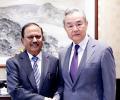
Wang is travelling to India days ahead of Prime Minister Narendra Modi's planned trip to the Chinese city of Tianjin to attend the annual summit of the Shanghai Cooperation Organisation.

Lavrov, who addressed the UN General Assembly shortly before External Affairs Minister S Jaishankar's speech at the high-level General Debate, said India and Russia share a "particularly privileged strategic partnership".

Though the two-day SCO Council of Foreign Ministers' meeting began at the Taj Exotica Resort in Benaulim on Thursday evening with a reception hosted by Jaishankar, the main deliberations took place on Friday.

India and Russia always stood "shoulder-to-shoulder" even in the most difficult situations, Prime Minister Narendra Modi told Russian President Vladimir Putin on Monday, against the backdrop of possibly the worst phase in New Delhi's ties with the US in over two decades.
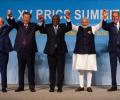
Dar also said Pakistan views Russia as an important player in the West, South and Central Asia, and strengthening mutually beneficial cooperation with Russia remains an important priority for Pakistan's foreign policy.

Prime Minister Narendra Modi condemned the violation of Qatar's sovereignty following Israeli air strikes on Doha, targeting Hamas leaders. He conveyed India's deep concern to the Emir of Qatar and reiterated support for peace and stability in the region.
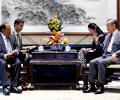
India and China are expected to discuss new confidence-building measures for durable peace and tranquillity along their contested border during Chinese Foreign Minister Wang Yi's two-day visit to India. The visit is seen as an effort to rebuild relations after the Galwan Valley clashes.
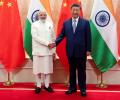
Prime Minister Narendra Modi and Chinese President Xi Jinping vowed to work towards a "fair, reasonable, and mutually acceptable" resolution of the festering boundary issue and pledged to work towards stabilising global trade.

India and Pakistan's admission to the Beijing-backed Shanghai Cooperation Organisation will be formalised at the grouping's summit in Kazakhstan next week, China said on Thursday.
Foreign secretaries of India and Pakistan would meet on June 29 in New Delhi to prepare the ground for the crucial meeting of the foreign ministers planned for the middle of July in Islamabad, Pakistan Foreign Secretary Jalil Abbas Jilani said in Beijing on Wednesday.

The two leaders shook hands and exchanged pleasantries at the end of the media briefing which was addressed by Chinese President Xi Jinping. China is the host and chair of the SCO.
Pakistan turned to China after the US refused it a civilian nuclear agreement.

Ahead of trade talks between Indian and United States officials in Delhi, White House trade advisor Peter Navarro said India, which has the 'highest tariffs' of any major country, is 'coming to the table'.
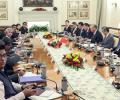
Chinese Foreign Minister Wang Yi's visit to India focuses on border talks with NSA Ajit Doval, amidst efforts to rebuild relations after the Galwan Valley clashes and rising India-US tensions.

The Galwan clashes indicate to the limitations in relations if they do not address border stability, points out Srikanth Kondapalli.
The Galwan clashes indicate to the limitations in relations if they do not address border stability, points out Srikanth Kondapalli.

The summit is also being attended by Pakistan Prime Minister Shehbaz Sharif, Iranian President Ebrahim Raisi and leaders of several central Asian countries.
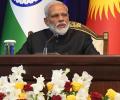
Modi hits out at trade protectionism and calls for a rule-based, transparent, anti-discriminatory, open and all inclusive WTO-centred multilateral trading system focused so that the interests of every country specially the developing ones can be taken care of.

'If China shows greater concerns for Indian interests, ties could improve. Otherwise, the thaw could be short-lived.'

In the first top-level contact since the Mumbai terror attacks, Prime Minister Manmohan Singh met President Asif Ali Zardari on Tuesday during which he is understood to have made it clear that Pakistan should take concrete action against terrorism directed against India.
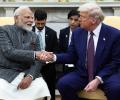
Prime Minister Narendra Modi on Saturday 'deeply' appreciated United States President Donald Trump's 'positive assessment' of the India-US partnership after the American leader hailed the 'special' relationship between the two nations -- remarks seen as an attempt to check the downturn in the ties.
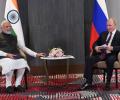
"I would like to wish India all the best. I also know that tomorrow, my dear friend, you are about to celebrate your birthday. "As per the Russian tradition, we never offer Congratulations in advance. So, I cannot do that right now," Putin said.
'Whenever it hears the term SCO, Delhi faces an existential dilemma -- of its own making.'

A joint declaration adopted at the end of the summit talks between Prime Minister Manmohan Singh and Russian President Dmitry Medvedev said Russia supported India's full membership in the Shanghai Cooperation Organisation.
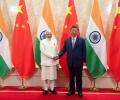
Prime Minister Narendra Modi and Chinese President Xi Jinping held bilateral talks focusing on economic ties and global stability amid trade tensions and the aftermath of the Ladakh border row.
Making a strong pitch for its full membership in the Shanghai Cooperation Organisation, India on Thursday said it sees a larger role for the security grouping in Afghanistan and evinced keen interest in participating in its counter-terrorism structure to combat challenges of extremism. India, Pakistan, Mongolia and Iran have the status of observer states. Afghanistan has been admitted as new observer during this summit. Belarus and Sri Lanka are the dialogue partners.

Prime Minister Narendra Modi on Thursday left for the Uzbek city of Samarkand to attend the Shanghai Cooperation Organisation (SCO) summit that will also see the participation of Russian President Vladimir Putin, Chinese President Xi Jinping and Iran's Ebrahim Raisi among other top world leaders.
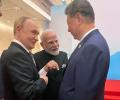
'Personalities are temporary, policies provide for stability.' 'With the former, when personalities change so does the nature of the relationship.' 'Policies and structures, on the other hand, are idiot-proof, as well as maverick-resistant,' explains Saisuresh Sivaswamy.

At the invitation of Prime Minister Narendra Modi, President Xi Jinping and PM Shehbaz Sharif will attend via video conference, the 23rd meeting of the Council of Heads meeting of the SCO on July 4.
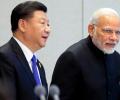
The Ministry of External Affairs (MEA) on Friday said Modi will lead the Indian delegation at the summit. "The prime minister will lead the Indian delegation to the 20th summit of the SCO council of heads of state which will be held in the virtual format on Nov 10. The meeting will be chaired by Russian President Vladimir Putin," MEA Spokesperson Anurag Srivastava said.

The 2025 US National Security Strategy marks a major pullback, with America turning backward and effectively allowing China greater dominance in Asia. while long-time partners like India are left to face an increasingly unstable global order largely on their own, observes Rajeev Srinivasan.
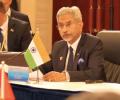
Jaishankar said the UN Security Council condemned the attack and underlined the need to hold perpetrators, organisers, financiers and sponsors of the reprehensible act and bring them to justice.

India-US relations, like Rome, were not built in a day, nor can they be demolished in a day.
All said and done, when the new global order emerges, India can only remain with the democracies, asserts Ambassador T P Sreenivasan.

Chinese Foreign Minister Wang Yi has called on India to implement the consensus reached by Prime Ministers Narendra Modi and Xi Jinping at their summit in Russia, urging a restart of bilateral ties. Wang emphasized the importance of respecting each other's core interests, enhancing mutual trust, handling differences effectively, and bringing the relationship back on track. He suggested practical steps such as resuming flights, easing visa procedures, and planning commemorative activities for the 75th anniversary of diplomatic relations. Wang also highlighted the shared interests and opportunities for cooperation between the two countries, advocating for mutual development and strengthening coordination in international affairs.
